
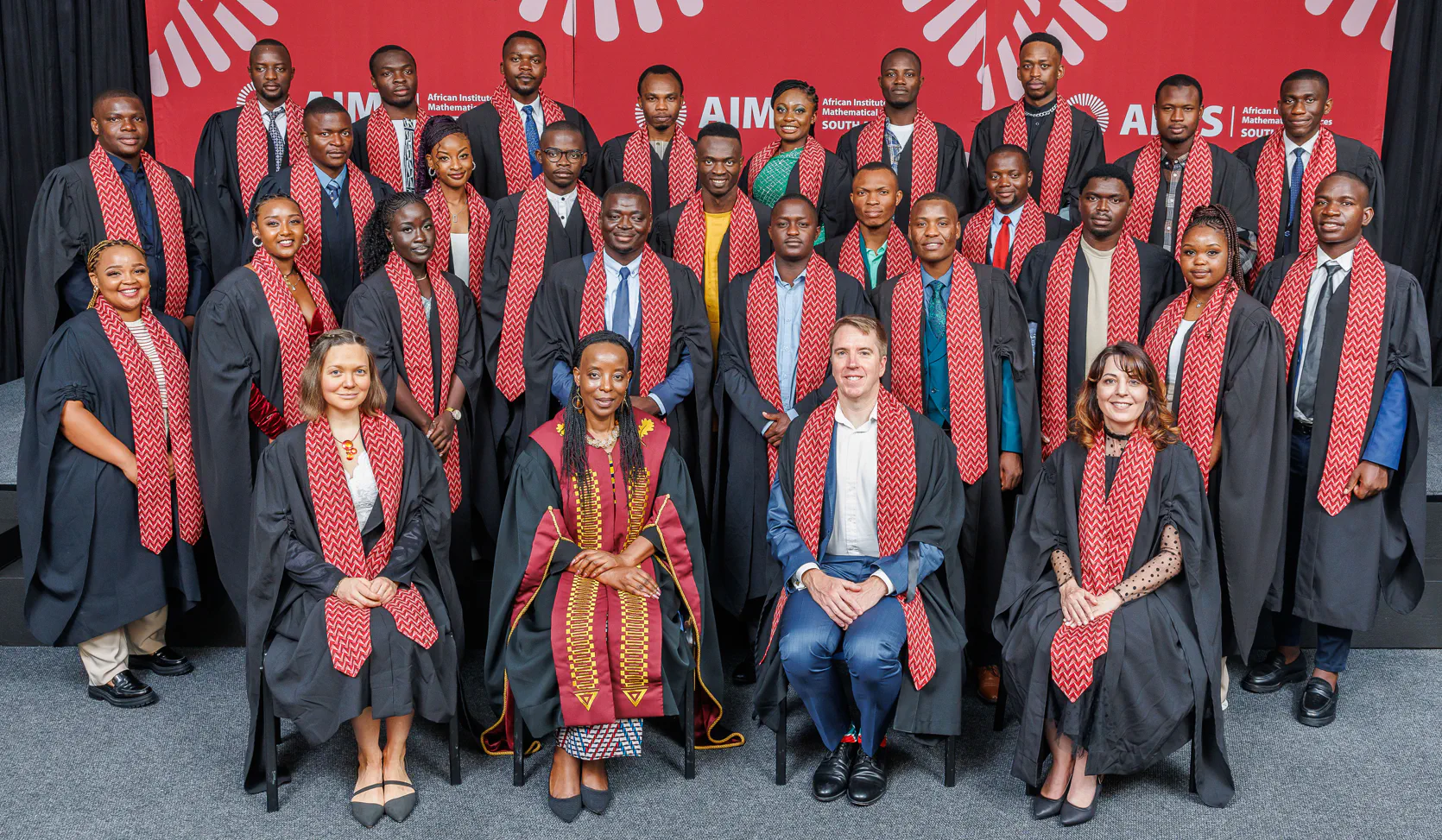
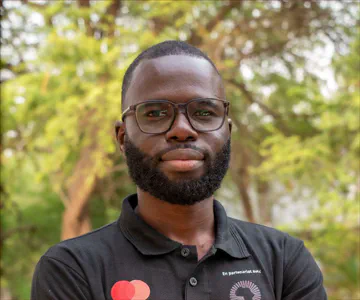
Kevin Belingar did not arrive at mathematics by design. He arrived by providence. There is a condition some call the Da Vinci Syndrome: the restless mind that cannot be contained by a single passion, that reaches in every direction at once, curious about everything and committed to nothing for long. Kevin knows it well. Growing up, he had many interests. But beneath all of them, one thing remained constant, undeniable, and entirely his own: computers. It was not a hobby he cultivated. It was something closer to a language he was born speaking. Growing up in Chad with limited access to computers, Kevin never had the luxury of spending hours tinkering freely with machines. And yet, what should have been a barrier became a kind of gift. He did not need to open them to understand them. The logic came naturally, without effort, as though it had always been there waiting. Cybersecurity, programming, the architecture of systems, these things made sense to him. When Kevin left Chad for Senegal, it was medicine that brought him across the border. He arrived with expectations, with plans, with the particular certainty of someone who believes he already knows the shape of his future. That certainty did not last long. Through a turn of events he did not anticipate, Kevin found himself redirected toward mathematics, physics, and computer science. At the time, it felt like a detour. Looking back, it was a calling. “God’s plan,” Kevin would later say, “is always greater than your own.” Mathematics became more than a subject. It became the language through which Kevin learned to think with precision and create without limits. The discipline of pure reasoning sharpened his logic. The beauty of abstract structures deepened his creativity. And beneath it all, his passion for computers never dimmed; it simply found a stronger, more rigorous foundation to stand on. He pursued his undergraduate degree in Pure Mathematics at Cheikh Anta Diop University in Dakar, followed by a first year of a master’s in Applied Mathematics. Then came AIMS Senegal. In October 2023, Kevin joined the African Institute for Mathematical Sciences, awarded the Mastercard Foundation Scholarship for academic excellence and leadership potential. From the first weeks, he understood he had stepped into something different. It was the intensity that struck him first. The curriculum at AIMS did not ease you in. It immersed you completely. The pace was relentless, the standards demanding, and the expectation was not merely to learn, but to think deeply, independently, and across disciplines. For a student with Kevin’s mathematical foundation and technical ambition, it was exactly the kind of environment where potential could be fully tested. But the transformation at AIMS went beyond the technical. Long before AIMS, Kevin’s father had given him a principle to live by: take advantage of the opportunities you face, because others are missing them. Not everyone gets the door. When it opens, you walk through it fully, without hesitation, without looking back. That quiet instruction shaped how Kevin moved through every challenge and every chance that came his way. Kevin arrived as someone who had always been more comfortable building systems than explaining them. At AIMS, that principle became a daily practice and that changed everything. Through the culture of rigorous debate, open inquiry, and constant presentation, he developed something equally valuable: the ability to argue. To anticipate counterarguments before they arrived. To walk into a room with not just an answer, but the reasoning behind it, clearly structured and ready to be challenged. He also discovered two kinds of creativity at AIMS and both left their mark. The first is the creativity of invention: the ability to imagine what does not yet exist and find a way to build it. The second is the creativity of resilience: the refusal to be stopped. If Plan A does not work, you do not stop. You do not accept the dead end. You think, you reframe, you find the angle no one else tried and you make it work. That is Plan B. Not a fallback, but a discipline. The capacity to adapt when the obvious path closes became one of the most defining skills Kevin carried out of AIMS, and one he uses every single day. The same discipline extended to how he communicated. Through repeated presentations and peer feedback, Kevin learned to translate technical complexity into accessible insight and understood that an idea that cannot be shared cannot create impact. That lesson was proven on a memorable stage. At the Deep Learning IndabaX Sénégal 2024, Kevin won the Poster Session for his research on applying Artificial Neural Networks to the Black-Scholes model work sitting at the intersection of deep learning and quantitative finance. He also placed second in the 3-Minute Master’s Thesis Defense competition. The recognition confirmed that his voice as a researcher had arrived. One of the quiet but powerful gifts of AIMS is its network of partners. For students stepping into an intense academic program far from home, knowing that a real-world internship is not just possible but facilitated and guaranteed through institutional partnerships brings a particular kind of confidence. It signals that the world beyond the classroom is already watching, already waiting. For Kevin, that opportunity came through Logidoo, an AIMS partner, where he worked as a Junior Data Scientist building computer vision models for logistics automation and translating raw data into systems that worked in the real world. It was the bridge between theory and impact that AIMS had always promised. He graduated with Distinction, ranked in the top two percent of his cohort. Graduation was not a finish line. It was a launch pad. That path led him to Babacar Birane, CEO of Concree and a committed partner of AIMS Senegal. One day, Babacar looked at Kevin and said: “Kevin, you can be in the Top 1 not just in Africa, but in the world.” Flattering, certainly. But Kevin received it not as praise, but as a charge. “With God, discipline, and work,” he said quietly, “I believe I can achieve something big.” Concree’s partnership with AIMS reflects exactly that spirit, a willingness to invest in talent, carry the AIMS vision forward, and build the kind of African innovation ecosystem where that ambition can become reality. Beyond his own studies, Kevin gave back consistently. He organized the inaugural AIMS Senegal Python Programming Competition, opening the door to the next generation of coders. He led Africa Science Week 2025, coordinating inclusive STEM activities for youth across West Africa including refugees and young people with disabilities. He co-organized Deep Learning IndabaX Sénégal 2025, contributing to the continent’s most important grassroots AI conference. The principle that guided all of it was simple: helping others is the best way to learn. Today, Kevin works as an AI Research Scientist at Concree in Dakar, at the frontier of artificial intelligence. He works on building agentic architecture systems where AI models reason, plan, and act and on understanding how the most advanced frontier models can be harnessed to build real solutions for African entrepreneurs and institutions. His work spans research on Large Language Models, fine-tuning, model alignment, and open-source AI development.
He also serves as Digital Community Coordinator at AIMS Senegal, driving alumni engagement, supporting entrepreneurs within the incubator, fostering collaboration with AIMS partners, and providing overall operational support to advance the institution’s mission ensuring that the AIMS community remains connected, active, and impactful long after graduation. The story, however, is far from finished. The Da Vinci Syndrome has not disappeared. If anything, it has expanded. Computer science vast, multidisciplinary, endlessly evolving is the one field wide enough to contain it. Cybersecurity, AI, finance, systems design: each is a world of its own, and Kevin moves through them with the ease of someone who was always meant to be there. Why did God bring him to this domain, through the winding path of medicine and mathematics and chance? The future, Kevin believes, will provide the answer. “God’s plan is always greater than your own,” Kevin said. “I came here for medicine. I ended up building the future of African AI. I would not change a single step.” The best African solutions are one idea away. And Kevin Belingar intends to be part of building them.