
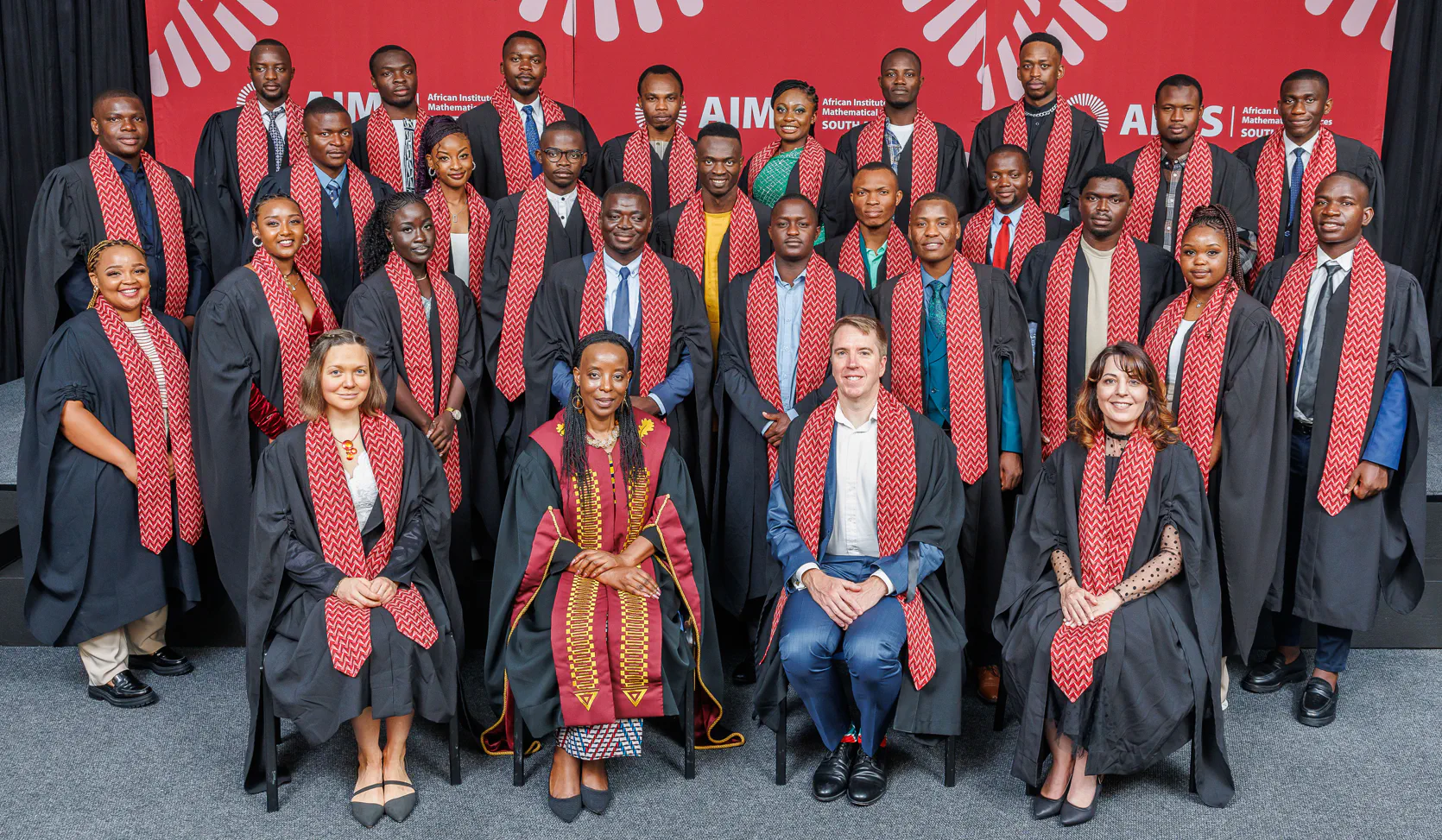
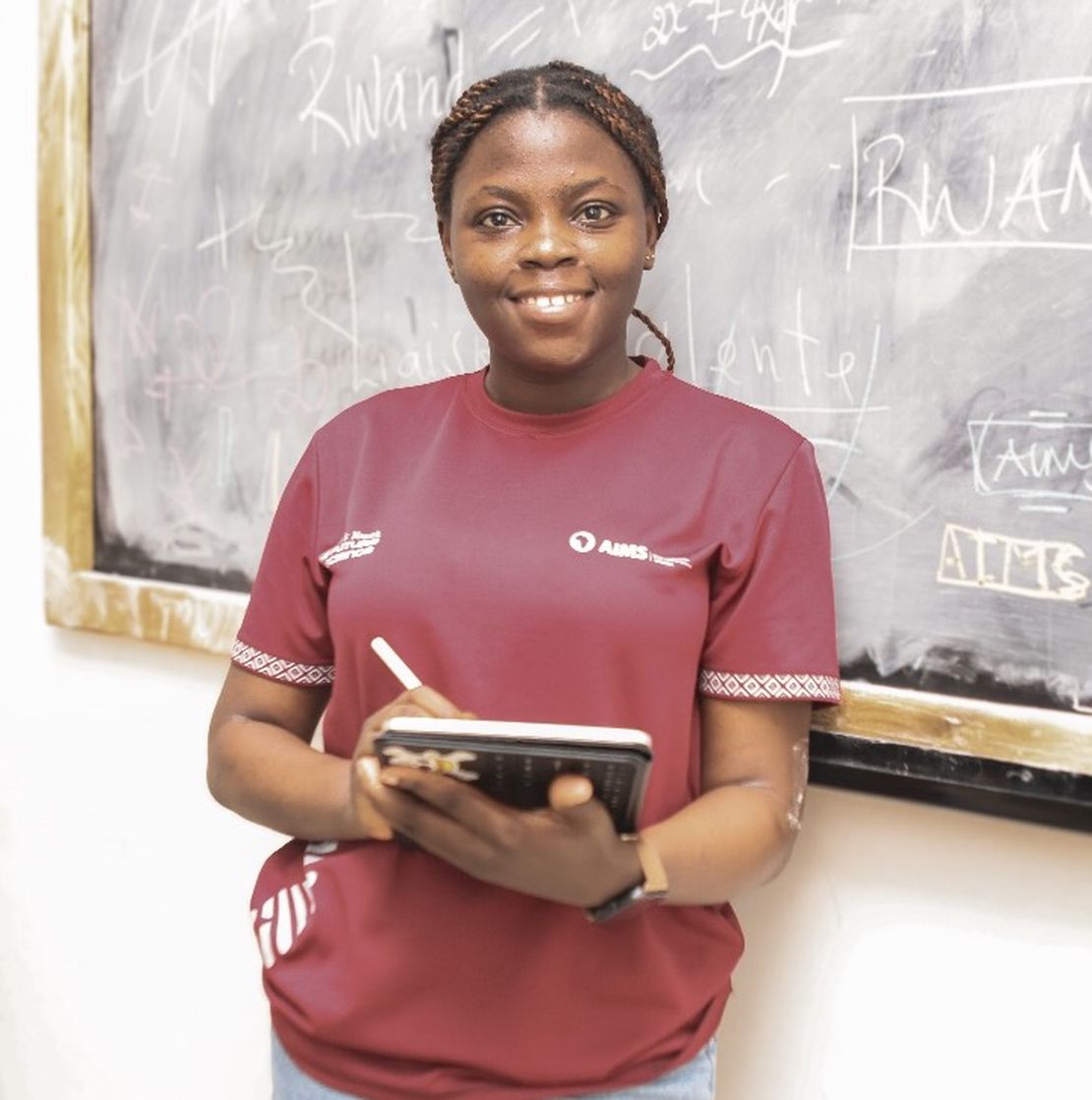
Carine IDANI, a Mastercard Foundation Scholar in the inaugural AIMS Co-Op Master’s in Mathematical Epidemiology, is transforming her lived experience with sickle cell anaemia into a data-driven mission to improve health outcomes for underrepresented communities across Africa. When Carine IDANI left her home in Benin to join the African Institute for Mathematical Sciences (AIMS) in Rwanda, she brought with her more than dreams of academic excellence. She carried the invisible weight of chronic illness, a quiet resilience built over years of silent endurance, and a heart set on using mathematics to make life better for others like her. Now 25, Carine is part of the inaugural Co-Op Master’s cohort in Mathematical Epidemiology, a practice-oriented program delivered by AIMS Research and Innovation Centre (AIMS RIC), AIMS Rwanda, and AIMS Cameroon in partnership with the Mastercard Foundation and the Africa Health Collaborative. The programme combines rigorous academic training with work-integrated learning, offering students structured internships where they apply classroom knowledge to real-world health challenges. Carine recently began her internship phase, where her skills are being tested and refined in real-time. But her journey did not start in a lecture hall. It began with pain.
Living With the Silence of Sickle Cell Carine lives with sickle cell anaemia, a genetic blood disorder that causes unpredictable and often excruciating pain episodes. Diagnosed late in adolescence, her condition shaped her school experience in ways many never saw. “I could miss school for weeks,” she says. “No one understood what was wrong. I looked fine from the outside, but inside, I was exhausted physically and emotionally.” As she grew older, Carine began to see beyond her pain. She started asking different questions. Why were conditions like hers so often mismanaged in poor communities? Why did accurate data on vulnerable populations remain scarce? Could she use her love for mathematics to fill these gaps?
Finding Purpose in Numbers Carine’s pivot toward public health was grounded in her undergraduate training in statistics, but it was at AIMS where everything shifted into focus. “I joined AIMS because it believes in the potential of young Africans,” she says. “They do not just teach you equations. They teach you how to solve the problems that matter to your people.” At AIMS Rwanda, she developed strong competencies in infectious disease modelling, simulations, and programming tools like R and Python. But beyond the academic rigor, Carine found something just as transformative: her voice!
Coming from a Francophone background, she initially struggled with English, the language of instruction. Yet, she soon emerged as a peer leader selected by her colleagues to serve as the Mastercard Foundation Scholar Representative. “I used to be quiet,” she says. “But at AIMS, I learned how to speak up for myself and for others. I started leading, organising, and representing. That was new for me. And it felt powerful.”
A Scientist with Empathy at the Core Now in her internship, Carine is applying her training to assess real-world health interventions. She is doing her internship at the Centre for Epidemiological Modelling and Analysis (CEMA) in Nairobi, supervised by Dr. Muema Mulei and Dr. Njoki Kimani. She is working on a project that models the potential reintroduction of trachoma in formerly eliminated areas. So far, it’s been a very enriching experience. She has improved both her modeling skills and her ability to extract policy-relevant insights from data. “It’s even more meaningful than I expected, especially because of the real-world health implications." Her goal is to evaluate how policies and programmes can be adapted to better reflect the complex realities of African communities where illness is shaped not just by biology, but by poverty, climate, culture, and access. “People often think science is cold and distant,” she says. “But for me, it is deeply human. Behind every dataset is someone who is struggling, someone who wants to be heard.” Carine hopes that her work will one day contribute to smarter, more inclusive health systems, especially for those who, like her younger self, fall through the cracks.
Honouring the Women Who Lifted Her She is the eldest of two children and has a younger brother. “When my father passed away, I was around 13. It was a difficult time for all of us, but especially for my mother. She had to deal with her grief while becoming both a mother and a father to us,” she says. What always struck her was how her mother never gave up on her own dreams, even in the middle of all that. “While I was in secondary school, she went back to pursue her education. Despite facing several failures, she kept trying and eventually earned her baccalaureate after my father’s death. That perseverance shaped who I am today.” When she received the opportunity to study abroad, her mother was proud but understandably worried, especially since she has health issues. Still, she let her go not because she wasn’t afraid, but because she had confidence in how she raised her: to be responsible, resilient, and able to handle challenges on my own. At first, only close family members knew about Carine’s scholarship. In her community, people can be very superstitious, and they don’t want to attract unnecessary attention. But once the news became known, many were surprised not because they didn’t believe in her, but because going abroad felt so far removed from what anyone around us had experienced.
A Message to Girls in Science To young African girls standing at the edge of self-doubt, Carine offers a message drawn from her own experience: “Start somewhere. Everything is hard until you take the first step. Our limits begin when we stop dreaming. You may come from a humble background, you may be living with illness or fear, but you belong in science. You belong in leadership.” Charting a Future of Possibility Carine’s story is more than a tale of overcoming adversity. It is a roadmap for how personal struggle can be turned into societal impact with mathematics as the medium. As she continues her training and prepares for what comes next, one thing is clear: Carine is not just building a career. She is modelling a future where science listens more, includes more, and cares more. Because, as she reminds us, “Numbers mean nothing unless they serve people.”