
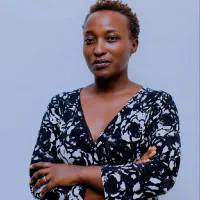
Brigitte Umutoni, a PhD fellow at AIMS RIC, is turning her personal journey of grief, grit, and growth into a digital solution that is becoming a lifeline for mothers across Rwanda. Brigitte Umutoni lost both parents at just four years old. Separated from her brother, she was taken in by her godmother, a dedicated primary school teacher in Rwanda’s Gicumbi District, who, despite having little, gave Brigitte everything: love, stability, and a deep respect for education. “She’d stay up late helping me with math, even though I hated it,” Brigitte recalls. “She saw something in me that I didn’t.”
That support laid the foundation for Brigitte’s future. Ironically, the subject she once dreaded became her greatest strength, and the key to unlocking her purpose.
Shattering Stereotypes and Owning Her Space in Science Brigitte’s journey into science began in secondary school, where she studied at Groupe Scolaire Notre Dame du Bon Conseil before moving on to take Physics, Chemistry, and Mathematics at Groupe Scolaire Officiel de Butare. Still, when she was placed into Applied Mathematics at university, she hesitated. “Math wasn’t seen as attractive or useful for girls. People didn’t think it could lead anywhere—especially for someone like me,” she says.
But in her final year, everything changed. A course in disease modeling opened her eyes to the power of mathematics. “For the first time, math felt alive. It wasn’t just numbers—it was a way to protect lives.”
That moment sparked a new sense of purpose. Brigitte went on to earn a Master’s in Statistics and Data Science with a focus on Epidemiology at Hasselt University in Belgium. Today, she’s back in Rwanda as a PhD fellow at the African Institute for Mathematical Sciences Research and Innovation Centre (AIMS RIC), in partnership with the University of Rwanda.
Her research project, “Climate-Informed Spatial Modelling for Predicting the Spread of Rift Valley Fever in Rwanda,” investigates the interaction between climate, animal health, and human health. By applying advanced mathematical tools to predict disease outbreaks across diverse regions, Brigitte is demonstrating how powerfully math and health are intrinsically connected.
Her story is proof that girls not only belong in science, they can lead it, solve real-world challenges, and reshape the future for generations to come.
Confronting the Quiet Challenges of Motherhood While deep in her PhD studies, Brigitte experienced a life-changing shift; she became a mother. What she expected to be a joyful chapter quickly turned into a confusing and lonely journey. The medical advice was often unclear, the support systems felt scattered, and no one seemed to talk openly about the emotional toll of new motherhood. “I felt lost and overwhelmed,” she recalls. “The information was either missing or contradictory. I started feeling anxious, isolated, and unsure of myself.”
As she slowly began to speak up, Brigitte discovered she wasn’t alone. Many young and first-time mothers were quietly struggling with the same fears and frustrations. That realization lit a spark in her—not just as a mother, but as a scientist and problem-solver. It was the beginning of her next big idea. Femora Care: Innovation Rooted in Empathy Motivated by her own struggles and those of countless other mothers, Brigitte founded Femora Care—a bilingual digital platform designed to support maternal health in Rwanda. Rather than building it in isolation, she co-created the app in close collaboration with expectant and new mothers, ensuring it reflected their lived realities.
Femora Care offers weekly, easy-to-understand guidance on pregnancy, baby development, nutrition, and mental health. It also includes tools like an AI-powered symptom checker, virtual consultations with midwives, coordinated home visits, and a peer mentorship network making maternal care more accessible and less overwhelming. Though still in its beta-testing phase, the platform is already making a difference. “My research taught me how to solve real-world problems,” Brigitte says. “Femora Care is an extension of that—people-centered, data-driven, and built around what mothers truly need.”
For Brigitte, the mission behind Femora Care is deeply personal. She puts it simply: “To ensure that every mother feels empowered and supported, with access to care, information, and services anytime, anywhere—because parenthood was never meant to be walked alone.”
In 2025, her innovation was nationally recognized when Hanga SRH selected Femora Care as one of Rwanda’s most promising social enterprises in sexual and reproductive health. With mentorship, funding, and real-time feedback from users and experts, Brigitte continues to refine the platform—bridging the gap between science and the everyday realities of motherhood.
A Tribute to the Women Who Build the Future Brigitte’s story is, at its heart, a tribute to the quiet heroines who shape lives without ever asking for recognition—women like her godmother. “She didn’t raise me because she had to,” Brigitte says softly. “She raised me because she believed I could be more than my circumstances. Her faith in me became the foundation for everything I’ve become.”
Her journey serves as a poignant reminder of the power of women who give selflessly, whether as mothers, teachers, mentors, or caregivers.
And so, to her godmother, and to every woman who has raised a child, biological or not, with grace and grit, Brigitte offers these words of gratitude: Thank you. Thank you for the sleepless nights spent teaching us lessons we resisted. Thank you for believing in our potential when the world only saw our limitations. Thank you for being our first cheerleaders, our quiet heroes, our builders of possibility.
Bridging Science, Leadership, and Inclusion at AIMS RIC Brigitte’s journey is a reflection of what AIMS RIC stands for—empowering African scientists to lead bold innovations and solve the continent’s most pressing challenges. But she is more than a researcher. She’s a changemaker working where health, technology, and gender equity meet, and doing so with both rigor and heart.
Her work challenges the idea that science and empathy exist in separate worlds. “Innovation must be inclusive,” she says. “We can’t design solutions for people without listening to their lived realities.”
Brigitte’s story sends a powerful message to girls who have grown up facing humble beginnings, loss, or being told that science isn’t for them. She’s walked that road, and now she’s lighting the way for others. “The world needs your voice and your mind,” she says. “Don’t underestimate yourself. Your background may not be privileged, but your dreams are valid. You belong in rooms of opportunity; in science, in leadership, and in innovation.”
A Vision Beyond the PhD Looking ahead, Brigitte dreams of growing Femora Care far beyond Rwanda, adapting it to different African communities, shaped by local realities, powered by data, and grounded in empathy. But no matter how far it reaches, her mission stays the same: to make sure no mother ever feels alone or unheard.
Brigitte Umutoni’s story is a powerful reminder of what’s possible when resilience meets purpose. From a little girl in rural Rwanda who lost her parents to a PhD researcher and founder of a life-changing digital health solution, her journey is not just about science. It’s about healing, hope, and using every setback as fuel to uplift others.