Professor Neil Turok, the founder of the AIMS Network and current Higgs Chair of Theoretical Physics at the University of Edinburgh, in a feature by target="_blank"
The Conversation, shares his latest insights on the fundamental questions shaping our understanding of the universe.
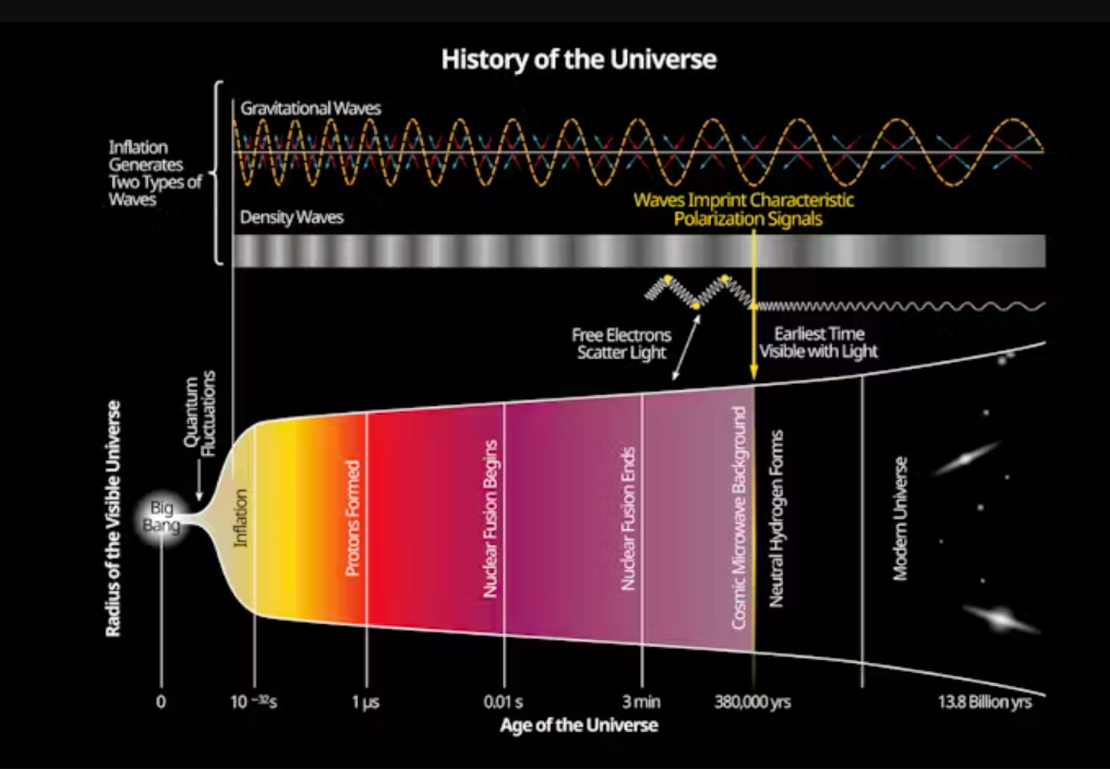
“We live in a golden age for learning about the universe. Our most powerful telescopes have revealed that the cosmos is surprisingly simple on the largest visible scales. Likewise, our most powerful “microscope”, the Large Hadron Collider, has found no deviations from known physics on the tiniest scales. These findings were not what most theorists expected. Today, the dominant theoretical approach combines string theory, a powerful mathematical framework with no successful physical predictions as yet, and “cosmic inflation” – the idea that, at a very early stage, the universe ballooned wildly in size. In combination, string theory and inflation predict the cosmos to be incredibly complex on tiny scales and completely chaotic on very large scales. The nature of the expected complexity could take a bewildering variety of forms. On this basis, and despite the absence of observational evidence, many theorists promote the idea of a “multiverse”: an uncontrolled and unpredictable cosmos consisting of many universes, each with totally different physical properties and laws.
So far, the observations indicate exactly the opposite. What should we make of the discrepancy? One possibility is that the apparent simplicity of the universe is merely an accident of the limited range of scales we can probe today, and that when observations and experiments reach small enough or large enough scales, the asserted complexity will be revealed.
The other possibility is that the universe really is very simple and predictable on both the largest and smallest scales. I believe this possibility should be taken far more seriously.”
Read full article by Prof. Turok, originally published by The Conversation target="_blank"
HERE.