In today’s digital era, the effectiveness of public institutions increasingly depends on how well they use data and the people who can transform that data into informed decisions.
Across Africa, governments are rapidly adopting digital systems that generate vast volumes of information. Artificial Intelligence and advanced analytics are increasingly embedded in these systems, shaping decisions about health, education, infrastructure, trade, and social protection. Preparing professionals who can responsibly harness these technologies has therefore become a strategic priority.
Recognizing this need, the African Institute for Mathematical Sciences (AIMS) partnered with the National Institute of Statistics of Rwanda (NISR) to design and deliver the Data Science Capacity Building Initiative (DSCBI); a rigorous applied training program aimed at strengthening advanced data science capabilities across Rwanda’s public sector.
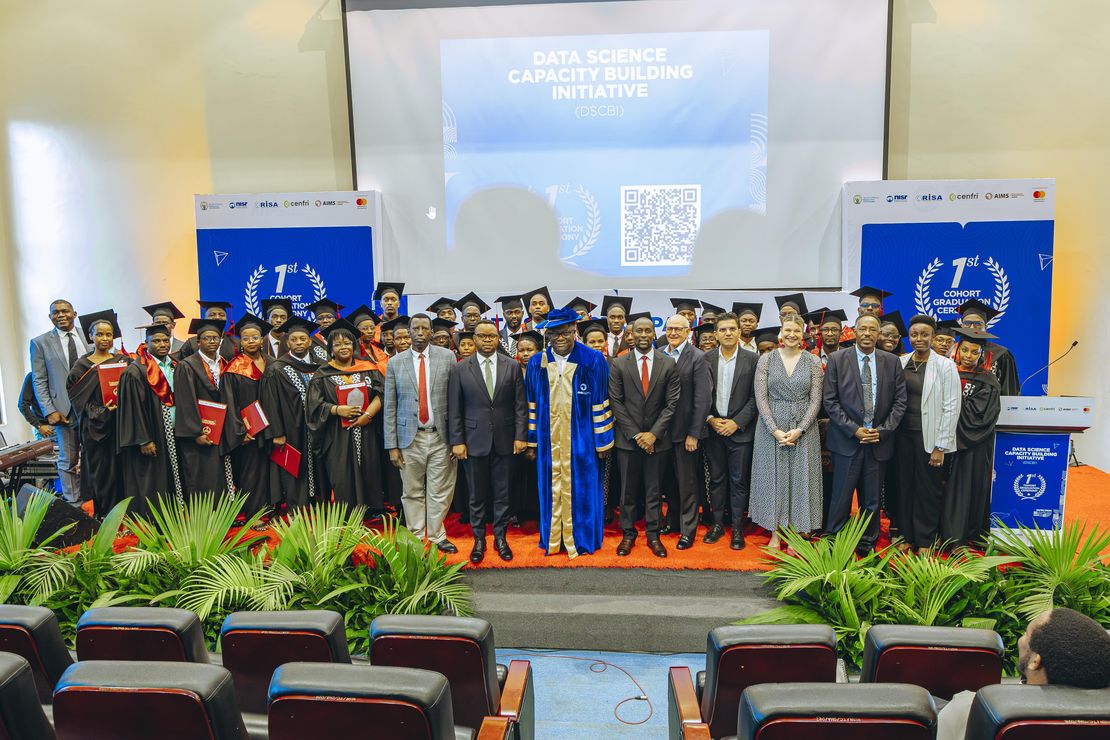
As Mr. Hennie Bester, Technical Director at CENFRI, emphasized during the graduation ceremony of the program’s first cohort:
AI is going to hardwire the decisions of our country in code. This means data scientists are going to be the keepers of society. Go forth and be custodians of that trust.
Through the DSCBI, AIMS brought its distinctive teaching and learning model built around applied mathematics, problem-solving, and real-world impact into the heart of Rwanda’s public institutions.
Rwanda has placed digital transformation at the center of its National Strategy for Transformation (NST2). As government services increasingly move onto digital platforms, institutions must develop the technical capacity to manage, analyze, and secure complex datasets.
The National Institute of Statistics of Rwanda (NISR) identified a critical skills gap across the broader National Statistical System (NSS) and government institutions: a shortage of highly trained professionals capable of converting raw data into actionable policy intelligence.
The Data Science Capacity Building Initiative, jointly designed by AIMS and NISR, was launched to address this gap through a structured and institutionally anchored training program rather than short-term workshops.

As Mr. Yves Iradukunda, Minister of State at Rwanda’s Ministry of ICT and Innovation, explained:
As a Ministry we have been in a journey of digital transformation, we have succeeded in many ways, making sure that infrastructure, devices are accessible be it in Education, Healthcare and many other services that we provide to the citizens. In that journey, we have been able to accumulate quite a sizable amount of data that should be analyzed and processed to give us capacity for decision-making. This program is very strategic and timely, because it allows us to build upon those efforts and investments to now have a Government that is data-driven and also to pave a path for our readiness to adopt emerging technologies including AI.
Building a Critical Mass of Government Data Scientists
Drawing on the AIMS pedagogical model, the DSCBI program adopted a demand-driven and competency-based approach tailored to the needs of government institutions.
Fifty professionals from across 12 institutions and 10 ministries were nominated to participate, including 29% women. Candidates underwent a comprehensive skills assessment to ensure the training curriculum responded directly to institutional priorities.
Participants completed the course “Applied Data Science with Python: Analytics, Machine Learning & AI,” which was structured around four core pillars of modern data science:
Data Engineering and Management – Python foundations, databases, APIs, and reproducible workflows.
Data Analysis and Applications – Structured, spatial, and time-series analysis using real-world datasets.
Machine Learning and AI – Core ML methods and emerging AI approaches including NLP and large language models.
Communication and Delivery – Visualization, dashboards, and end-to-end capstone projects.
The program was closely monitored and evaluated throughout its implementation to ensure measurable outcomes.
Key results from the first cohort include:
41 government professionals certified in data science.
30% women participation, strengthening gender inclusion in advanced technology fields.
24 institutional capstone projects implemented across ministries and government agencies.
Strengthened collaboration across Rwanda’s National Statistical System.
But beyond technical training, the program focused on embedding practical skills into daily institutional workflows.
As Dr. Dunstan Matekenya, DSCBI Lead Trainer and Data Scientist at the World Bank Group, noted:
Having delivered data science training across multiple countries in Africa and beyond, what distinguished this program was its strong emphasis on real-world application. By requiring participants to work on practical data use cases drawn directly from their institutions, the training ensured that skills were not only learned, but immediately applied in their day-to-day work.
Participants also strengthened their ability to communicate insights effectively—an essential skill for influencing decision-making within government.
From Records to Real-Time Insights
Historically, many institutions managed data primarily as static records. Today, participants of the DSCBI are equipped to build automated data pipelines, connecting data sources such as databases and APIs directly to analytical dashboards and decision-support tools.
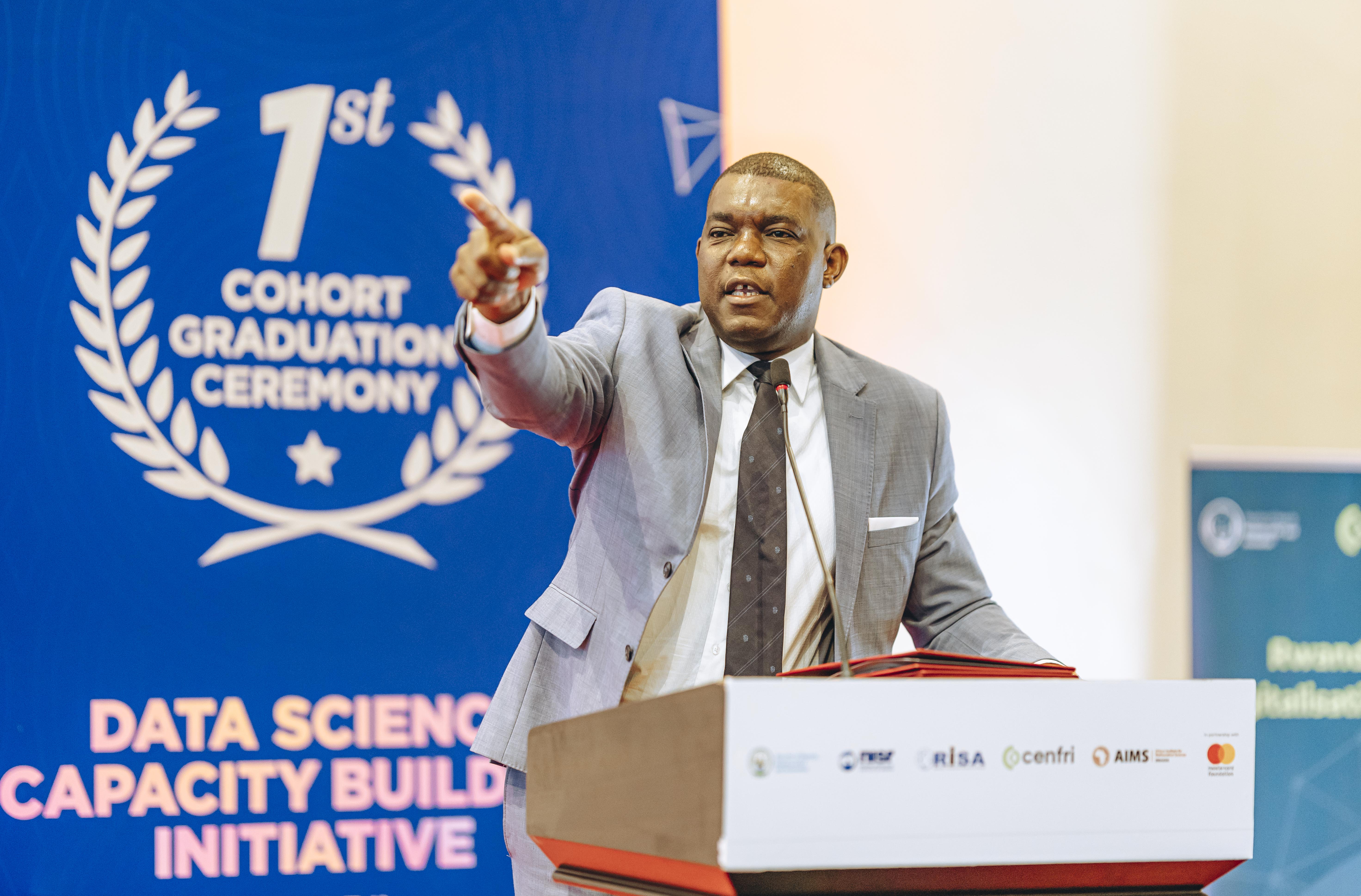
Mr. Ivan Ntwali, Country Director of Mastercard Foundation Rwanda, highlighted this transformation:
Data is no longer just records; it generates insights into current realities. Your dedication, discipline and willingness to learn demonstrates your strong commitment to strengthening your institutions and advancing the use of data in a timely, reliable and impactful way.
This shift represents more than professional upskilling; it marks an institutional transition toward data-driven governance.
The success of the DSCBI reflects a strong collaboration between AIMS, NISR, CENFRI, government institutions, and development partners.
Mr. David Nkusi, Head of Corporate Services at NISR, reflected on the value of this collaboration:
This initiative reflects the strength of our growing institutional partnerships and our shared commitment to advancing data science skills and promoting evidence-based decision making across government institutions.
Participants demonstrated the impact of this training through a range of capstone projects addressing real institutional challenges.
Use Case 1: AI-Powered Policy Assistant for the Government of Rwanda | Developed by Mr. Janvier Niyitegeka, Overall Top Achiever of DSCBI.
To address the growing complexity of government policy documentation, Mr. Niyitegeka built an AI-powered Policy Assistant that allows users to search and interpret policy documents through a conversational interface.
Using retrieval-augmented generation (RAG) and multilingual AI, the system indexes policies into a secure vector database and enables accurate retrieval of information in English, French, and Kinyarwanda.
Impact:
Improved policy accessibility, reduced misinterpretation, and strengthened evidence-based decision-making across government systems.
Use Case 2: Data Discovery Chatbot for the Rwanda Revenue Authority | Developed by Mrs. Marie Mediatrice Iradukunda, Top Female Achiever of DSCBI.
Fragmented data systems often make it difficult for staff to identify and access the information they need. Mrs. Iradukunda developed an AI-powered Data Discovery Chatbot that allows staff to query institutional datasets using natural language.
The system also integrates metadata standards to strengthen data governance and clarity around data ownership.
Impact:
Improved transparency, faster data discovery, and more efficient decision-making.

Beyond Completion: A Foundation for Scale
For Mrs. Therese Uwimana, Director of Data Revolution and Big Data at NISR, the graduation ceremony represented more than the end of a training program:
This event is not just about completion, but about impact. About the skills built, the partnerships strengthened, and the future we are shaping through data and evidence-informed decision making for our institutions and our country.
The success of the first cohort has generated growing demand from additional government institutions, validating the model developed through the AIMS-NISR partnership.
The upcoming second cohort aims to:
Increase enrollment to 60 professionals.
Raise women’s participation to 38%.
Deliver 30 additional institutional data use cases.
Deepen AI integration across public systems.
Investing in Africa’s Data-Driven Future
Investing in public sector data and AI capacity produces long-term systemic impact—improving governance efficiency, strengthening service delivery, and building sustainable institutional expertise.
Prof. Dr. Abebe Geletu W. Selassie, German Research Chair in Applied Mathematics and AI at AIMS Rwanda, captured this broader vision:
As Africans, we must grow with the times and accelerate with technology, especially AI embedded across fields and hardware. We have to start making things by ourselves.
The Data Science Capacity Building Initiative demonstrates how AIMS’ expertise in advanced mathematics and data science can directly support governments in building the human capital needed for responsible AI adoption and digital transformation.
As demand grows, scaling initiatives like DSCBI will be critical to shaping Africa’s next generation of public sector data and AI leaders.
The successful implementation of the first cohort of the DSCBI was made possible through a strong three-way partnership between NISR, CENFRI, and AIMS. By leveraging resources from Phase 2 of the Rwanda Economy Digitalization (RED) Program, these institutions collaboratively delivered the DSCBI with meaningful impact.
All enquiries must be sent to
industry.initiative@aims.ac.rw
.